It’s official: the Summer holidays are over and we are back! To celebrate, we’ve brought out our new catalogue . It captures some famous sporting moments, such as Botham in 1981, Laker in 1956, England football in 1966,the West Indies cricket team in 2003 and a signed (by James Hunt himself, Graham Hill, Tony Brise, Denny […]
It’s surprising to learn that John Astley Cooper first proposed what has become the Commonwealth Games in 1891: 5 years before the Modern Olympics. The plan was to hold a sports competition every four years “as a means of increasing goodwill and understanding of the British Empire”. Committees were set up throughout the Empire to […]
What is the England v Australia Ashes Origin Story?
What is the England v Australia Ashes Origin Story?
As we all know, the England v Australia rivalry in cricket goes back a long way but do you know the details of the Ashes Origin Story? The first test match between the two countries was in 1877 when James Lillywhite led an England team on a tour to Australia and New Zealand. England and Australian teams then took it in turns to tour and play in each other’s country. In 1882 the Australian team came to England and events took a fateful turn.
The Ashes Origin story began on the 29th August 1882 at the Oval when Australia had its first Test win on English soil. England lost by a nailbiting, heartbreaking 7 runs. A journalist in the Sporting Times wrote a witty ‘obituary’ for English cricket, saying, “…in affectionate remembrance of English cricket, which died at the Oval on the 29th August 1882.” He went on to say that ‘its body will be cremated and the Ashes taken to Australia’, where England was due to play Australia again a few weeks later.
England captain, the Hon. Ivo Bligh, immediately took up the cudgel. He vowed to regain those ashes and the media dubbed the subsequent tour as the ‘Quest to Regain the Ashes’. When England won 2 out of the 3 Tests, some women presented him with a tiny urn, labelled, ‘The Ashes of Australian Cricket’ with some ashes inside. The original urn is now in the MCC museum at Lord’s
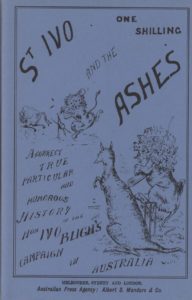
St Ivo and the Ashes, Ivo Bligh’s cricket campaign in Australia
You can read more about the origin of the Ashes and Hon Ivo Bligh’s Campaign to reclaim them in the great book, ‘St Ivo and the Ashes’. The next Ashes campaign was in England in 1884 and England won again. The 1884 Ashes included the inaugural Test at Lord’s. England won there with some spectacular batting from AG Steel and a catch for England…by the Australian captain! Weirdly he was standing in for his friend, WG Grace, who was off the pitch at the time – a time of more fluid cricket match rules!
Australia and England have won almost the same number of Ashes contests since they began. There have been 73 Ashes campaigns since 1882. Australia have won 34 and retained the Ashes 6 times from draws. England has won the Ashes 32 times and retained them once from a draw. Let’s hope England get’s closer to evening up the score this time.
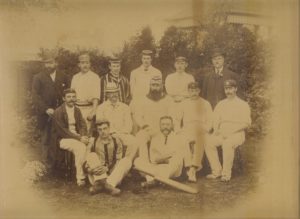
The 1884 England cricket team at the inaugural Ashes Test match at Lord’s
Graham Thorpe RIP: one of our Farnham local heroes
It’s just not cricket…or is it?
It’s just not cricket…or is it? Cricket as a sport has always been seen as one steeped in good manners. In recent years, however, we have all lived through incidents of ball tampering and match fixing in recent cricket matches. Is this a recent phenomenon? Or despite cricket’s gentlemanly reputation, has cunning behaviour been a part of the sport since its beginning?
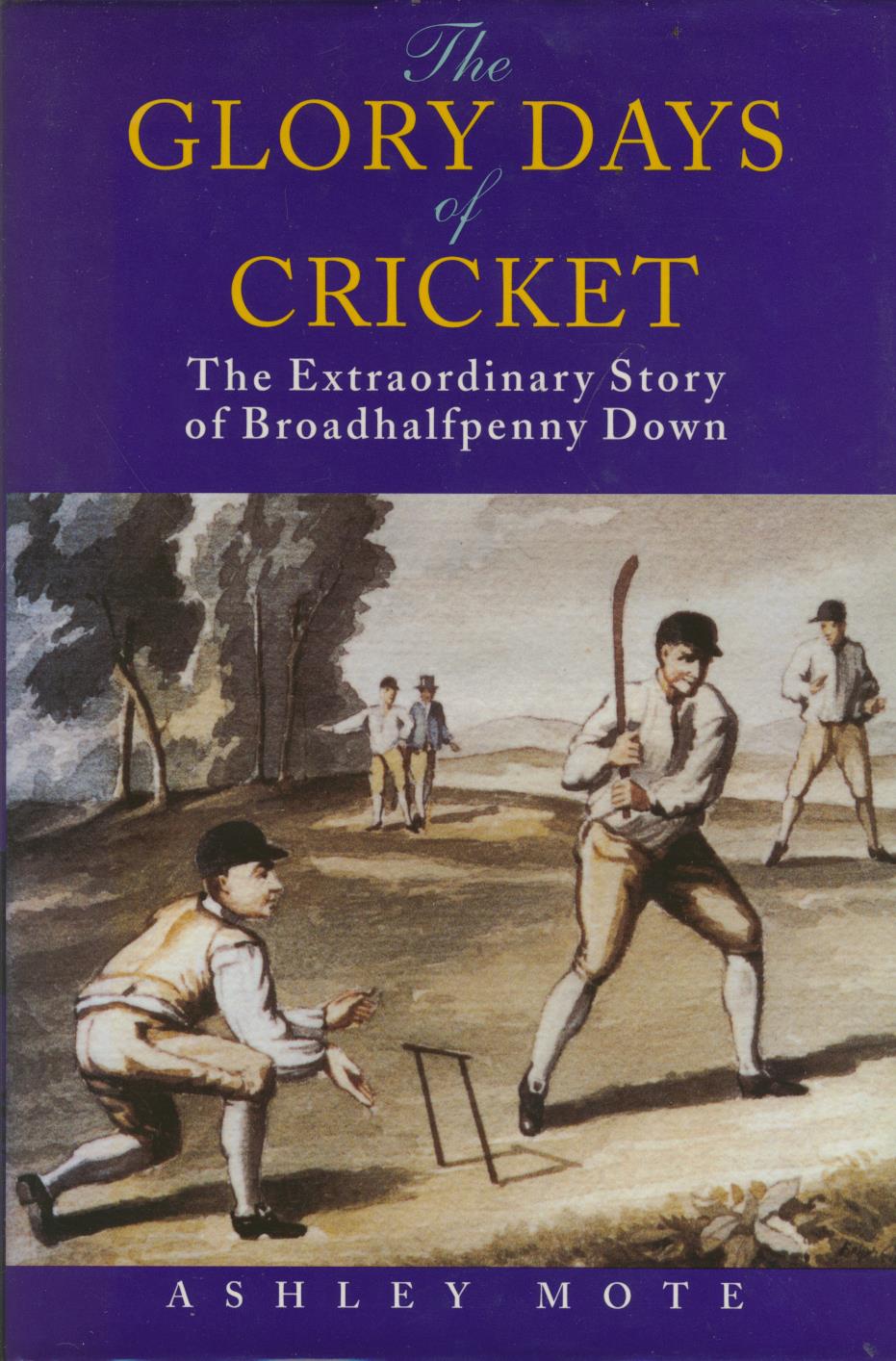
One of the sport’s earliest organised matches was between Chertsey and the world’s first cricket club, Hambledon. Hambledon had an extremely strong team, including leading bowler, Thomas Brett, and captain, Richard Nyren. They hadn’t bargained on a genius batsman from Chertsey however. Thomas ‘Shock’ White came out to bat…with a bat as wide as the stumps! At that point, a bat as wide as you like was perfectly legal. It hadn’t yet occurred to anyone to play with an outrageously wide bat or to restrict their dimension. Funnily enough, Hambledon quickly put in a formal written protest and by 1774 the Laws of Cricket had been changed. The legal width of a bat was restricted to today’s maximum size of 10.8 cm.
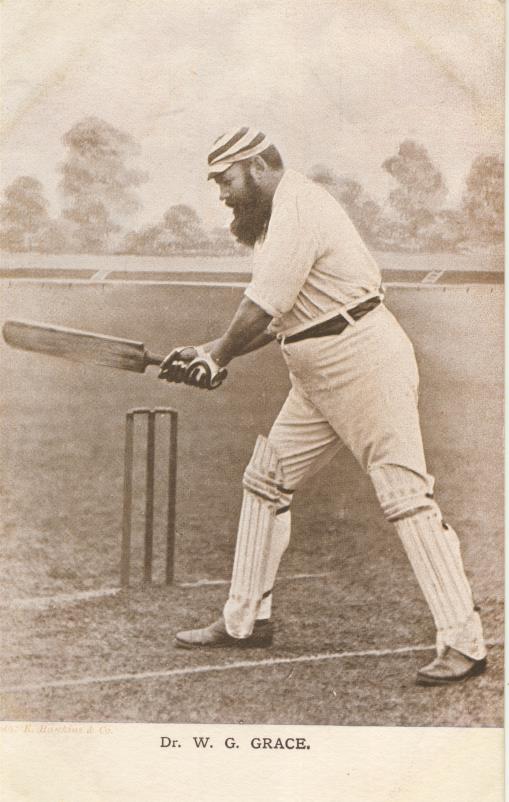
One of the greatest cricketing names in history had a slightly questionable reputation for ‘gentlemanly behaviour’: W G Grace. Grace was known to be a notorious sledger – generally frowned on if not actually illegal in cricket. The great batsman was also said to have at times ignored being bowled out. He simply replaced the bails after a bowler had disturbed his wicket and carried on batting regardless. He was claimed to have told the ‘offending’ bowler, “They’ve come to watch me bat, not you bowl”, which may have been fair comment too. Obviously we all want well behaved, legal cricket teams to support and matches to watch but nothing beats a cricket match nailbiter to watch, especially with a bit of controversy thrown in too!