Our most recent New Stock catalogue has a huge range of sports as usual. It also has quite a fine line in rare and classic fitness and wellbeing books too. Any of them should help you get ready for the summer! One of the most direct of the fitness and wellbeing books is ‘Be Fit […]
This quirky, 1930s Hungarian table tennis postcard is in our newest New Stock catalogue: https://www.sportspages.com/catalogue/new-stock-58 along with over 100 other items from nearly as many sports. Our catalogues come out regularly: don’t miss them by signing up for them on the bottom of our home page!
What is the England v Australia Ashes Origin Story? As we all know, the England v Australia rivalry in cricket goes back a long way but do you know the details of the Ashes Origin Story? The first test match between the two countries was in 1877 when James Lillywhite led an England team on […]
The 1954 Wimbledon Lawn Tennis Championship
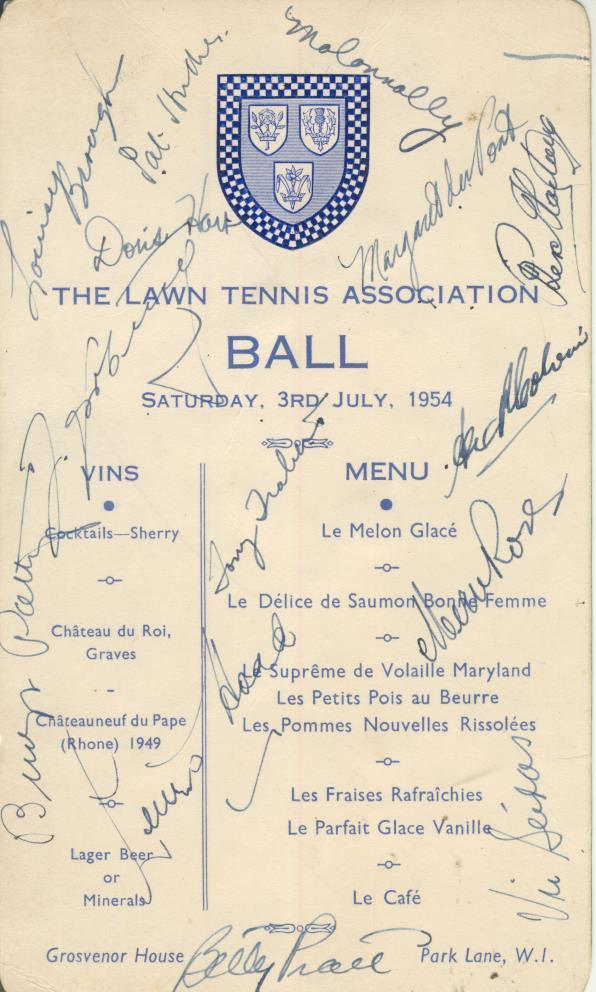
THE 1954 LAWN TENNIS ASSOCIATION’S DINNER MENU – SIGNED BY MANY WIMBLEDON CHAMPIONS
The 1954 Wimbledon Tennis Championship was hugely significant for its two eventual champions: Male singles champion, Jaroslav Drobny and female singles champion, ‘Little Mo’ Maureen Connolly. 32 year old Drobny won his first and only Wimbledon title in 1954 after 11 previous, unsuccessful attempts. He also won the competition as an Egyptian citizen, the only Egyptian citizen to do so in the history of Wimbledon. For 19 year old ‘Little Mo’ Connolly, already a phenomenon in tennis, the 1954 women’s Wimbledon title was to be her third and unexpectedly her last. They, along with several of their finalists, signed this dinner menu for the ball (code: 38174), celebrating the end of that year’s Wimbledon competition.
Jaroslav Drobny was a Czech sports star, excelling in both tennis and ice hockey. When he won Wimbledon, he achieved a number of firsts. He was the first and only male tennis player to win Wimbledon, wearing glasses! Over his long tennis career, he also competed at Wimbledon under 4 different national identities. In 1938 he entered the championships as a Czech citizen. By the following year Germany had invaded Czechoslovakia. So Drobny competed under the Protectorate of Bohemia and Moravia. In 1948 a coup led to a Communist government in Czechoslovakia. Drobny was subjected to travel restrictions, which limited his tennis career. So in 1949 Drobny and his doubles partner defected while in Switzerland. Drobny tried unsuccessfully to become a Swiss citizen. Then he tried for American and then Australian citizenship. Finally he was successful – Egypt granted him citizenship and so Drobny became the first Egyptian citizen to win a Grand Slam title!
In 1954 Drobny defeated a young 19 year old in the final, Ken Rosewall, who would become one of the greatest male tennis players of all time. In his early days, however, his fellow tennis players called him ‘Muscles’ for his lack of them. He was small, 5’7″ and he was skinny. But he was also fast, agile, tireless and had a deadly volley. Like ‘Little Mo’, a fellow Wimbledon finalist in 1954, Rosewall was only 19 in 1954. He had something else in common with her too. Both Little Mo and Ken Rosewall were natural left handers, who had been taught by their respective fathers to play right handed instead. It’s hard to imagine how good they might have been if they had been allowed to continue left handed.
Little Mo was already a tennis superstar in 1954. In 1953, aged just 18, she had become the first woman to win all 4 Grand Slam tournaments during the same calendar year. 1954 was to be her third win at Wimbledon…and unexpectedly her last. Little Mo had been brought up by her mother and her aunt after her parents’ divorce when she was 3. Little Mo had at first wanted to become a horse rider. She turned to tennis because her mother couldn’t afford horse riding lessons. In 1954 Wimbledon finished on the 2nd July. Presumably Little Mo decided to treat herself to a bit of her favourite hobby after the championships. So it was on the 20th July, only two and a half weeks after the tennis tournament finished, that Little Mo had a terrible riding accident that ended her tennis career.
We found this fantastic footage of all the key Wimbledon players of 1954 – a great slice (not too much pun intended) of Wimbledon history You can see how cool Drobny was in his glasses and how slight Ken Rosewall was…as was Little Mo’ for that matter!
Pele’s sport memorabilia auction
Pele’s historic sport memorabilia auction:
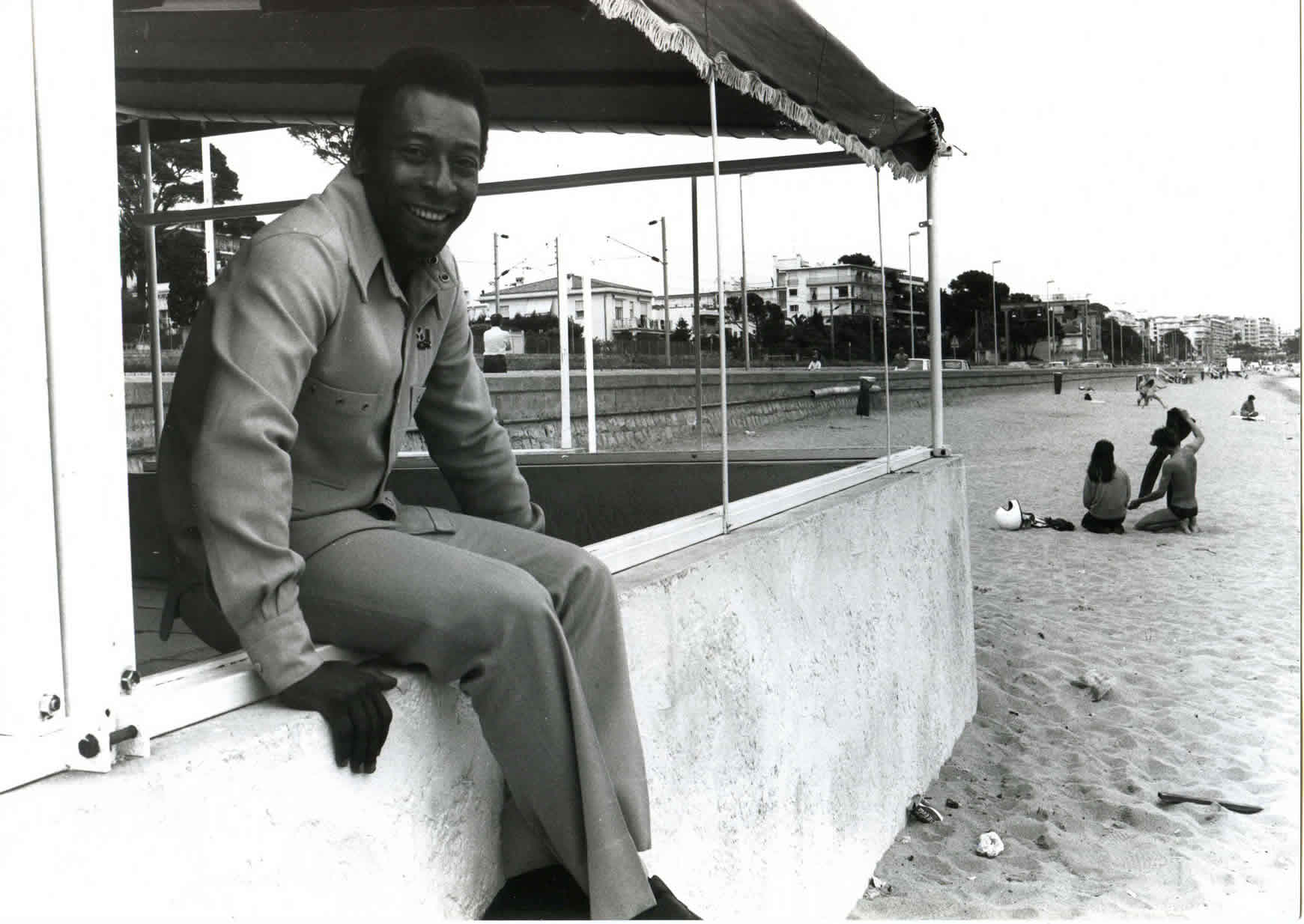
The biggest sport memorabilia auction in history has had us gripped over the last few days. Pele, arguably the greatest footballer in history, is selling a huge swathe of his collection of memorabilia from his football career. The auction offers over 6000 items of Pele ‘history’ to be won. Pele has explained why he is selling them. He wants fans and collectors to own a piece of his history. He is also giving a portion of the money to Brazil’s largest paediatric hospital. Presumably he is also keeping some income from the sale for himself – that is allowed! We think we can safely say that Pele has ‘paid his dues’ in footballing history.
Pele on the beach at Cannes, 1981
Pele is the only footballer in history to have won the World Cup 3 times. One of the items in the auction is a one-off replica of the World Cup Jules Rimet Trophy. It was made especially for Pele and presented to him after Brazil’s World Cup triumph in 1970. The trophy was estimated to sell for £200,000. It has gone for £395,000. Boots that Pele wore in the film, ‘Escape to Victory’ have been sold for over £8,000! Pele scored over 1000 goals in 1363 matches and appeared 91 times for Brazil. On sale too was the ball with which he scored his 1000th goal.
Some more surprising items were in the sale too. A riding crop, embroidered with Pele’s full name, was snapped up. A gourd rattle, presumed from an indigenous Amazonian tribe, was on offer too. Closer to home was a clear globe paperweight. The paperweight contains a tuft of original turf grass from the pitch at Wembley! It was presented to Pele in 2002 at the Final Ball event just before Wembley Stadium was demolished to be rebuilt. The globe’s inscription includes, ‘A little piece of Wembley to take home’.
We confess that we have dabbled in this historic sport memorabilia auction too. Look out on the website for a few fantastic Pele items appearing in the coming months. We snapped up some great bits of Pele history. Sadly, that doesn’t include the replica Jules Rimet Trophy!
1957 Chelsea Football Club
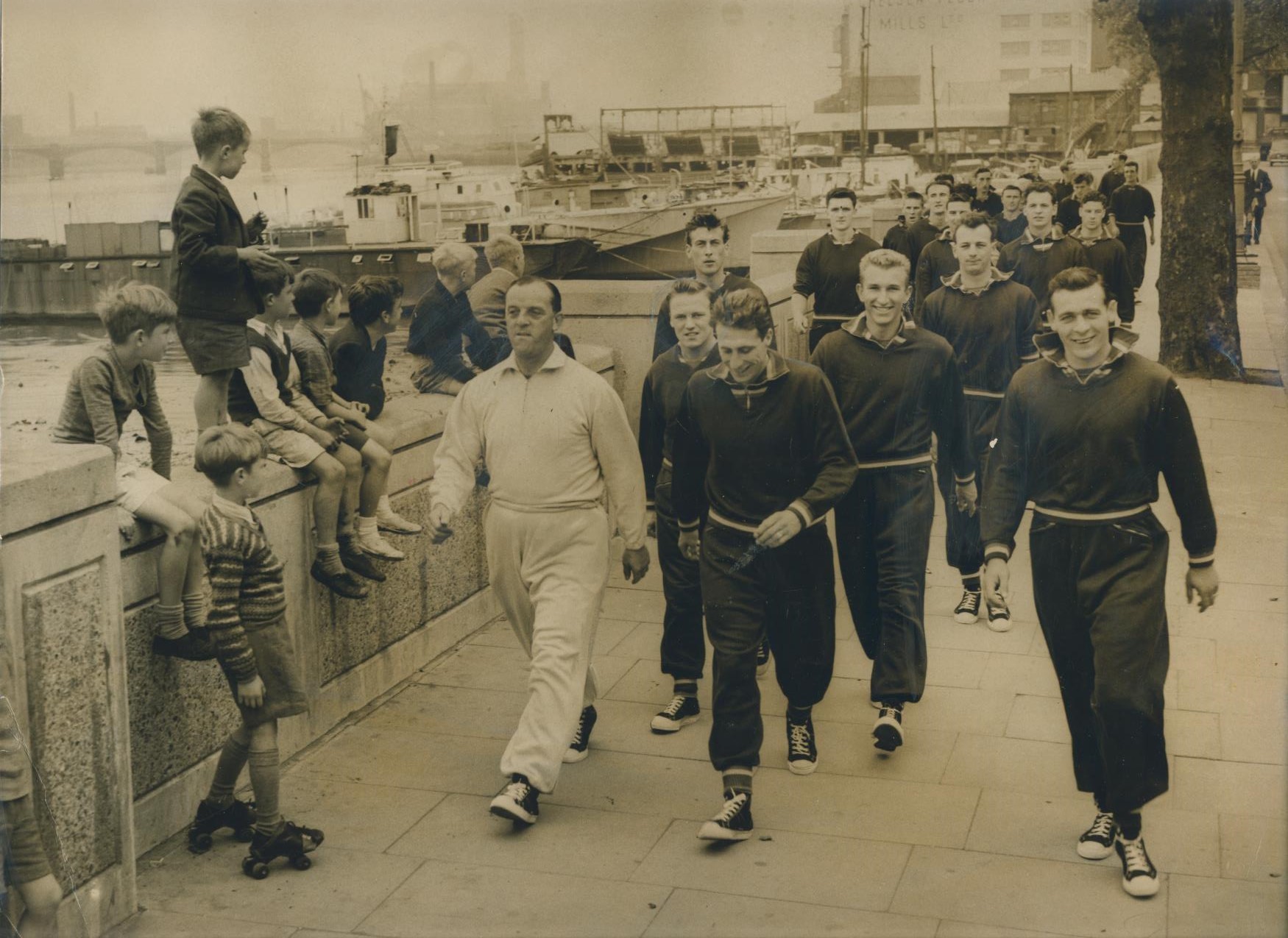
Enjoy a great image of 1957 Chelsea football players being led on a training walk by their then coach, Arthur Tennant. We love this press photograph – a fantastic time capsule and snapshot of a Chelsea football team, who probably felt reasonably confident that they were on the up and up by that point. They had enjoyed their first major trophy success a couple of years earlier by winning the League Title in 1955. In 1957 they were preparing to debut at their first European competition: the 1957-58 Inter-Cities Fair Cup. Chelsea had in fact been invited to their first European competition two years earlier in 1955. The French football magazine, L’Equipe, had invited them to take part in the inaugural 1955 UEFA European Cup. The Football League blocked Chelsea’s participation, however. They felt the tournament would be a distraction to domestic football!
1957 Chelsea football players training on the Chelsea embankment
The young and ambitious Ted Drake had been managing Chelsea since 1952 and by 1957 he had remodelled Chelsea football club and its players significantly. Drake had brought in successful, new signings and improved the youth set up. He changed the club’s image fundamentally too – gone was the old ‘Pensioners’ crest. In came the rebranded ‘Blues’. Perhaps this press photograph is part of that rebranding? A jaunty shot of the ‘Blues’ on a training walk in their training kit and very cool, uniform trainers!
It’s fascinating to see how freely the players were able to walk through central London with little sense of being mobbed by the public. It’s also amazing to see the children watching the players as they pass by – what child would be able to stand atop the embankment wall with his/her back to the Thames now?!
Cricket Scorecards: Sportspages’ New catalogue
Rare & unusual Cricket Scorecards – our new cricket catalogue is out. We’ve struggled to keep the item numbers down in the catalogue. There are simply too many cricket scorecards with great stories to tell on our website! Some of the scorecards stand out due to their age. An I Zingari v the Liverpool Club cricket match took place on 19th July 1859. An extremely rare scorecard from the first ever Australian Tour of England in 1878 tells a painful early story of England Cricket.
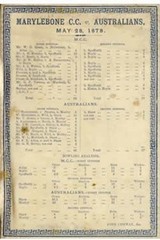
MCC v Australians 1878 Cricket Silk Scorecard
The game was at Lord’s. Somehow the Australians scored only 41 yet won the match by 9 wickets. England, led by WG Grace, were bowled out twice in an afternoon, scoring just 33 and 19. The scorecard belonged to Alick Bannerman, the famous “stone-waller”, and has his name printed to the reverse.
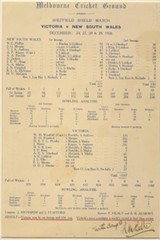
VICTORIA V NEW SOUTH WALES 1926 (RECORD SCORE OF 1107)
Another cricket scorecard stands out due to the match’s extraordinary score. On 24-29th December 1926 Victoria amassed a still unbeaten First-Class record score against New South Wales at Melbourne. Victoria made 1107 runs over the five days. Ponsford was top scorer, having made 352 runs. Arthur Mailey was hit for a soul-destroying 362 runs in his 64 8-ball overs. New South Wales lost – unsurprisingly – by an innings and 656 runs. It remains only the third heaviest defeat in history…so far.
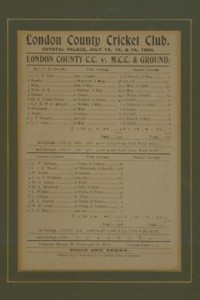
Other cricket scorecards in the catalogue tell stories that bring in outside elements to cricket itself. Footballing legend Geoff Hurst’s only First Test Match score was in a cricket match in 1962 . Another of the cricket scorecards in our catalogue introduces a significant element of interest outside cricket. In July 1902 London County played the MCC at Crystal Palace. London County won by an innings with Wood, Poidevin and WG Grace all scoring centuries for County. But the real intrigue is the appearance of one Sir A Conan Doyle for the MCC team, who scored his highest first-class score in the match. He made 43 runs.
Sir Arthur Conan Doyle’s appearance for the MCC in 1899
Sir Arthur Conan Doyle (1859-1930) was a hard hitting, though not especially skilled, batsman and a bowler of slow, loopy lobs which often took a puzzling flight. Indeed he once quipped that so slow was his bowling that if he ever delivered one he didn’t fancy could run down the wicket, intercept it, and come back for another go! In 1899, for the MCC, he took seven for 61 against Cambridgeshire at Lord’s and on the same ground two years later carried out his bat for 32 against Leicestershire. It is said that Shacklock, the Nottinghamshire player, inspired him with the Christian name of his famous character, Sherlock Holmes, and that of the latter’s brother Mycroft was suggested by the Derbyshire cricketer of that name.
If a picture tells a 1000 stories, it turns out cricket scorecards tell 1000s more! There are many more stories told by the cricket scorecards in our catalogue and on our website. Take a look.