Our most recent New Stock catalogue has a huge range of sports as usual. It also has quite a fine line in rare and classic fitness and wellbeing books too. Any of them should help you get ready for the summer! One of the most direct of the fitness and wellbeing books is ‘Be Fit […] More…
This quirky, 1930s Hungarian table tennis postcard is in our newest New Stock catalogue: https://www.sportspages.com/catalogue/new-stock-58 along with over 100 other items from nearly as many sports. Our catalogues come out regularly: don’t miss them by signing up for them on the bottom of our home page! More…
What is the England v Australia Ashes Origin Story? As we all know, the England v Australia rivalry in cricket goes back a long way but do you know the details of the Ashes Origin Story? The first test match between the two countries was in 1877 when James Lillywhite led an England team on […] More…
We’re eagerly awaiting the start of this year’s Ryder Cup. We’ve been testing ourselves – and failing – on what we know about its history. So we did a bit of digging and here’s what we found: Samuel Ryder originally sponsored the Ryder Cup after watching a friendly transatlantic match at Wentworth in 1926. Ryder […] More…
Who will light the flame at the Olympics in Brazil tomorrow? The big money is on the ‘King of Football’, possibly Brazil’s greatest national treasure, Pelé. The International Olympics Committee has already, and quite rightly, honoured Pelé twice this year. In June Thomas Bach, IOC president, awarded Pelé the Medal of the Olympic Order, the Games’ highest honour. On the 22nd July, the Olympic torch was passed to Pelé in the town of Santos at the Pelé museum. Santos was, of course, where the great footballer’s career began.
In 1999 the IOC named Pelé its athlete of the century. He has been officially declared ‘Best Football Player of the 20th Century’ several times. Sadly for him, however, he was never able to play football in the Olympics themselves. His international, professional career began in spectacular fashion at the 1958 World Cup in Sweden. As a 17 year old boy he scored two of the winning goals against home team, Sweden, in the World Cup Finals. At that time only amateur sportsmen were allowed to take part in the Olympics. Professional sportsmen were only admitted to the Games in 1986. So Pelé was prevented from ever being an ‘Olympian’ footballer- he jokes that that’s why Brazil has never won there!
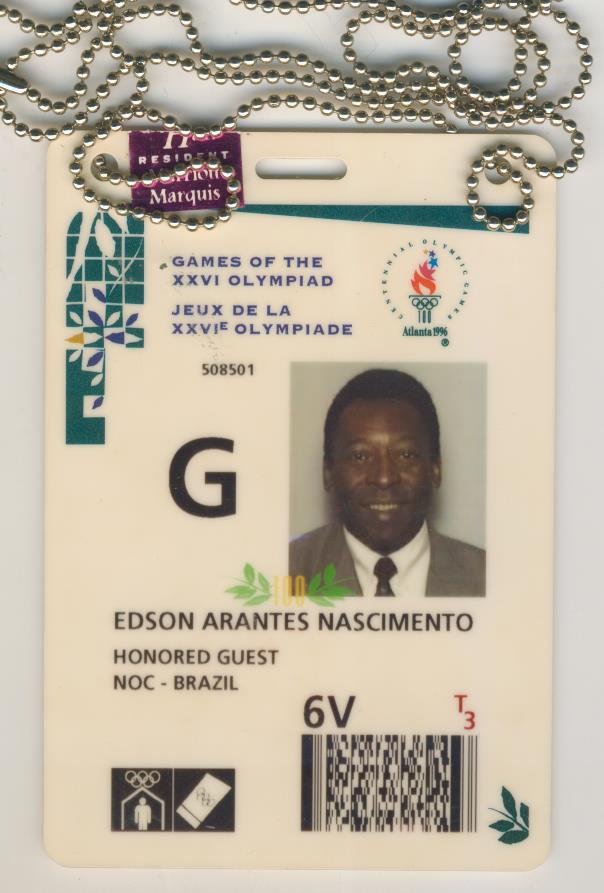
Pele at the Olympics, Atlanta 1996
When Thomas Bach presented Pelé with his Medal of the Olympic Order he said of the Brazilian, “In everything he does, both on and off the field, he exemplifies the Olympic values of excellence, friendship and respect.” Although he may not have played in the Olympics, Pelé has been involved in the Olympic movement massively over the years. We know for a fact that he was an ‘Honored guest’ at the 1996 Atlanta Olympics, because we have recently acquired his accreditation pass for those games, a cracking piece of sports memorabilia and sport history. There he watched his great friend, Muhammad Ali, light the torch with dignity and great ceremony. It will be fitting and equally symbolic to watch the great Brazilian footballer, Edson Arantes do Nascimento, doing the same at the Opening Ceremony in Brazil 2016.
We were very sad to learn belatedly of the death of John Gaustad in June this year. John Gaustad was the visionary bookseller, who set up a treasure trove of sports books in Caxton Walk, off Charing Cross Road in London. It became a legendary book shop for sports fans, especially football fans. Gastaud called it Sportspages.
John Gaustad, Sportspages
When New Zealand born Gaustad founded Sportspages in 1985, he developed the world of sports books writing and collecting hugely. So many sports books collectors we deal with today still have fond memories of spending hours at the Caxton Walk Sportspages. Our very own Magnus Bowles spent many a happy hour there, browsing, reading… and then finally buying!
Matthew Engel’sobituary for John Gaustad in the Guardiangives a great sense of the man and the impact of his passion for sports books: . We sadly never met him and inherited the legendary name when the Sportspages shop closed down in 2005. We still receive calls from its original customers, checking to see if we might be one and the same. Our Sportspages is slightly different of course with much more emphasis on sports books and memorabilia from days gone by and a much broader focus on all sports. We hope, however, John Gaustad would be pleased with Sportspages’ reincarnation: we can only aspire to many of his achievements, such as Muhammad Ali coming to do a signing at the Caxton Walk bookshop, but we certainly share the same passion for the breadth and depth of sports books and memorabilia. We hope too that we do some justice to supporting his fantastic legacy in the sports book industry.
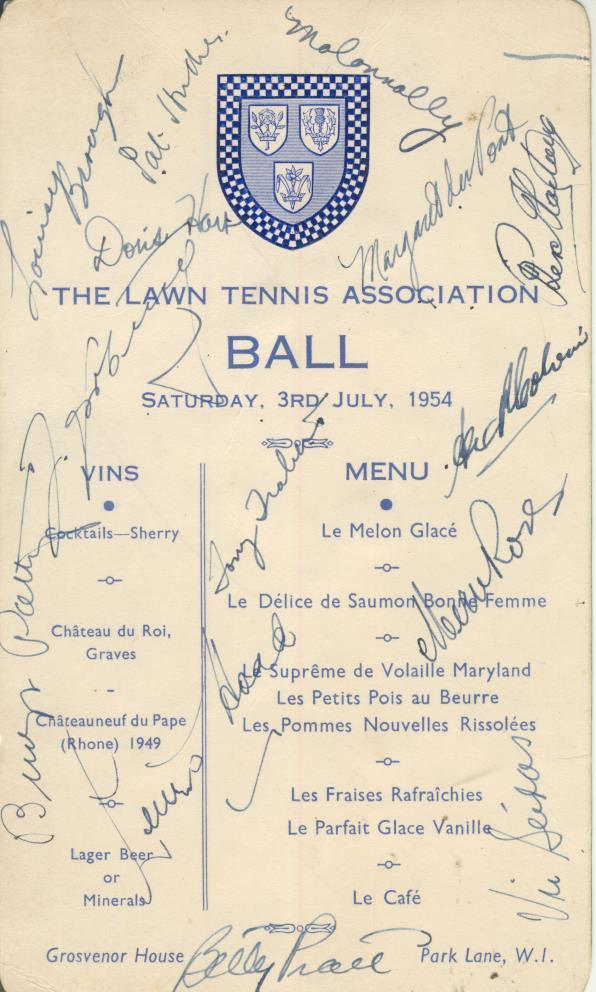
THE 1954 LAWN TENNIS ASSOCIATION’S DINNER MENU – SIGNED BY MANY WIMBLEDON CHAMPIONS
The 1954 Wimbledon Tennis Championship was hugely significant for its two eventual champions: Male singles champion, Jaroslav Drobny and female singles champion, ‘Little Mo’ Maureen Connolly. 32 year old Drobny won his first and only Wimbledon title in 1954 after 11 previous, unsuccessful attempts. He also won the competition as an Egyptian citizen, the only Egyptian citizen to do so in the history of Wimbledon. For 19 year old ‘Little Mo’ Connolly, already a phenomenon in tennis, the 1954 women’s Wimbledon title was to be her third and unexpectedly her last. They, along with several of their finalists, signed this dinner menu for the ball (code: 38174), celebrating the end of that year’s Wimbledon competition.
Jaroslav Drobny was a Czech sports star, excelling in both tennis and ice hockey. When he won Wimbledon, he achieved a number of firsts. He was the first and only male tennis player to win Wimbledon, wearing glasses! Over his long tennis career, he also competed at Wimbledon under 4 different national identities. In 1938 he entered the championships as a Czech citizen. By the following year Germany had invaded Czechoslovakia. So Drobny competed under the Protectorate of Bohemia and Moravia. In 1948 a coup led to a Communist government in Czechoslovakia. Drobny was subjected to travel restrictions, which limited his tennis career. So in 1949 Drobny and his doubles partner defected while in Switzerland. Drobny tried unsuccessfully to become a Swiss citizen. Then he tried for American and then Australian citizenship. Finally he was successful – Egypt granted him citizenship and so Drobny became the first Egyptian citizen to win a Grand Slam title!
In 1954 Drobny defeated a young 19 year old in the final, Ken Rosewall, who would become one of the greatest male tennis players of all time. In his early days, however, his fellow tennis players called him ‘Muscles’ for his lack of them. He was small, 5’7″ and he was skinny. But he was also fast, agile, tireless and had a deadly volley. Like ‘Little Mo’, a fellow Wimbledon finalist in 1954, Rosewall was only 19 in 1954. He had something else in common with her too. Both Little Mo and Ken Rosewall were natural left handers, who had been taught by their respective fathers to play right handed instead. It’s hard to imagine how good they might have been if they had been allowed to continue left handed.
Little Mo was already a tennis superstar in 1954. In 1953, aged just 18, she had become the first woman to win all 4 Grand Slam tournaments during the same calendar year. 1954 was to be her third win at Wimbledon…and unexpectedly her last. Little Mo had been brought up by her mother and her aunt after her parents’ divorce when she was 3. Little Mo had at first wanted to become a horse rider. She turned to tennis because her mother couldn’t afford horse riding lessons. In 1954 Wimbledon finished on the 2nd July. Presumably Little Mo decided to treat herself to a bit of her favourite hobby after the championships. So it was on the 20th July, only two and a half weeks after the tennis tournament finished, that Little Mo had a terrible riding accident that ended her tennis career.
We found this fantastic footage of all the key Wimbledon players of 1954 – a great slice (not too much pun intended) of Wimbledon history You can see how cool Drobny was in his glasses and how slight Ken Rosewall was…as was Little Mo’ for that matter!
The biggest sport memorabilia auction in history has had us gripped over the last few days. Pele, arguably the greatest footballer in history, is selling a huge swathe of his collection of memorabilia from his football career. The auction offers over 6000 items of Pele ‘history’ to be won. Pele has explained why he is selling them. He wants fans and collectors to own a piece of his history. He is also giving a portion of the money to Brazil’s largest paediatric hospital. Presumably he is also keeping some income from the sale for himself – that is allowed! We think we can safely say that Pele has ‘paid his dues’ in footballing history.
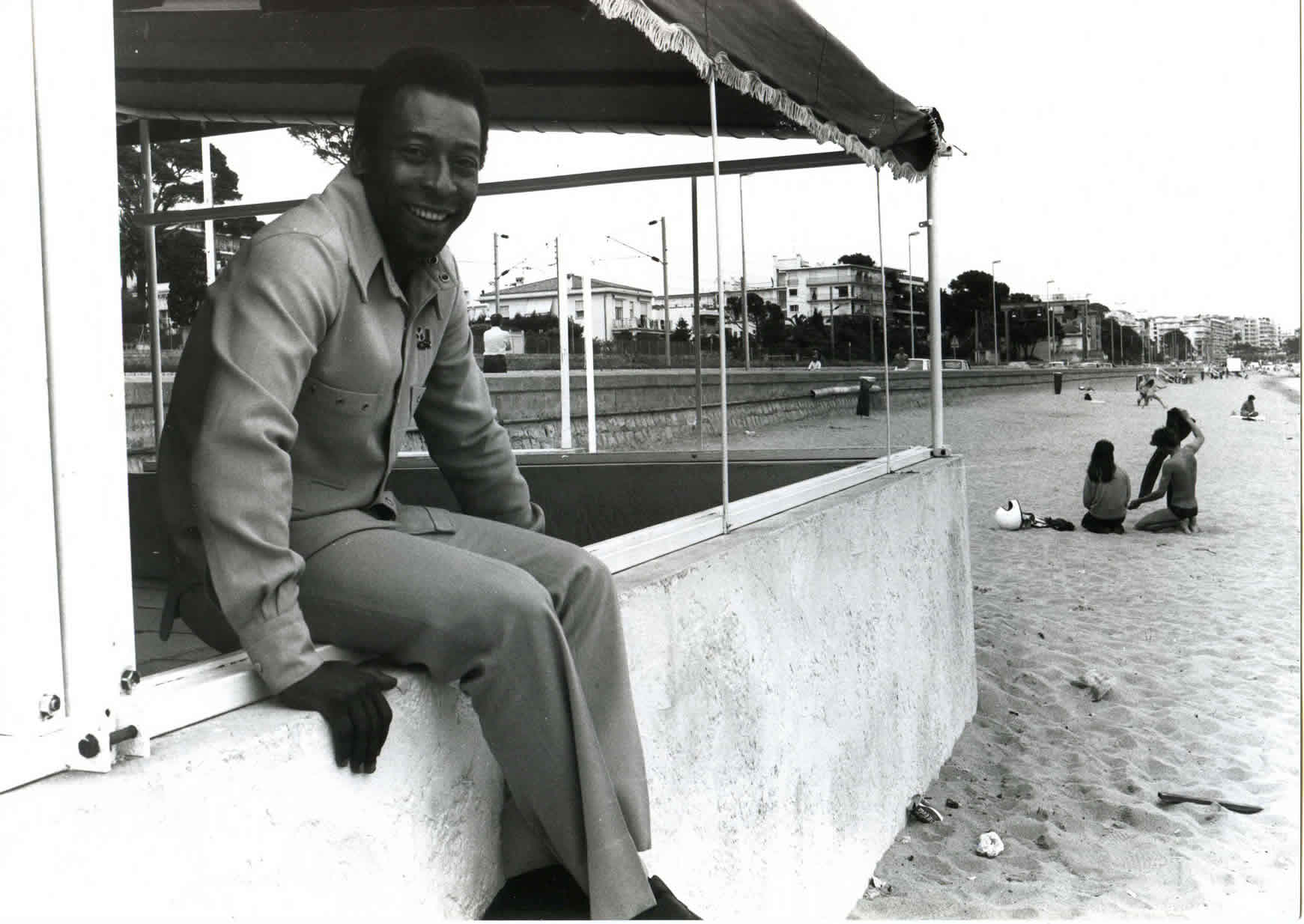
Pele on the beach at Cannes, 1981
Pele is the only footballer in history to have won the World Cup 3 times. One of the items in the auction is a one-off replica of the World Cup Jules Rimet Trophy. It was made especially for Pele and presented to him after Brazil’s World Cup triumph in 1970. The trophy was estimated to sell for £200,000. It has gone for £395,000. Boots that Pele wore in the film, ‘Escape to Victory’ have been sold for over £8,000! Pele scored over 1000 goals in 1363 matches and appeared 91 times for Brazil. On sale too was the ball with which he scored his 1000th goal.
Some more surprising items were in the sale too. A riding crop, embroidered with Pele’s full name, was snapped up. A gourd rattle, presumed from an indigenous Amazonian tribe, was on offer too. Closer to home was a clear globe paperweight. The paperweight contains a tuft of original turf grass from the pitch at Wembley! It was presented to Pele in 2002 at the Final Ball event just before Wembley Stadium was demolished to be rebuilt. The globe’s inscription includes, ‘A little piece of Wembley to take home’.
We confess that we have dabbled in this historic sport memorabilia auction too. Look out on the website for a few fantastic Pele items appearing in the coming months. We snapped up some great bits of Pele history. Sadly, that doesn’t include the replica Jules Rimet Trophy!
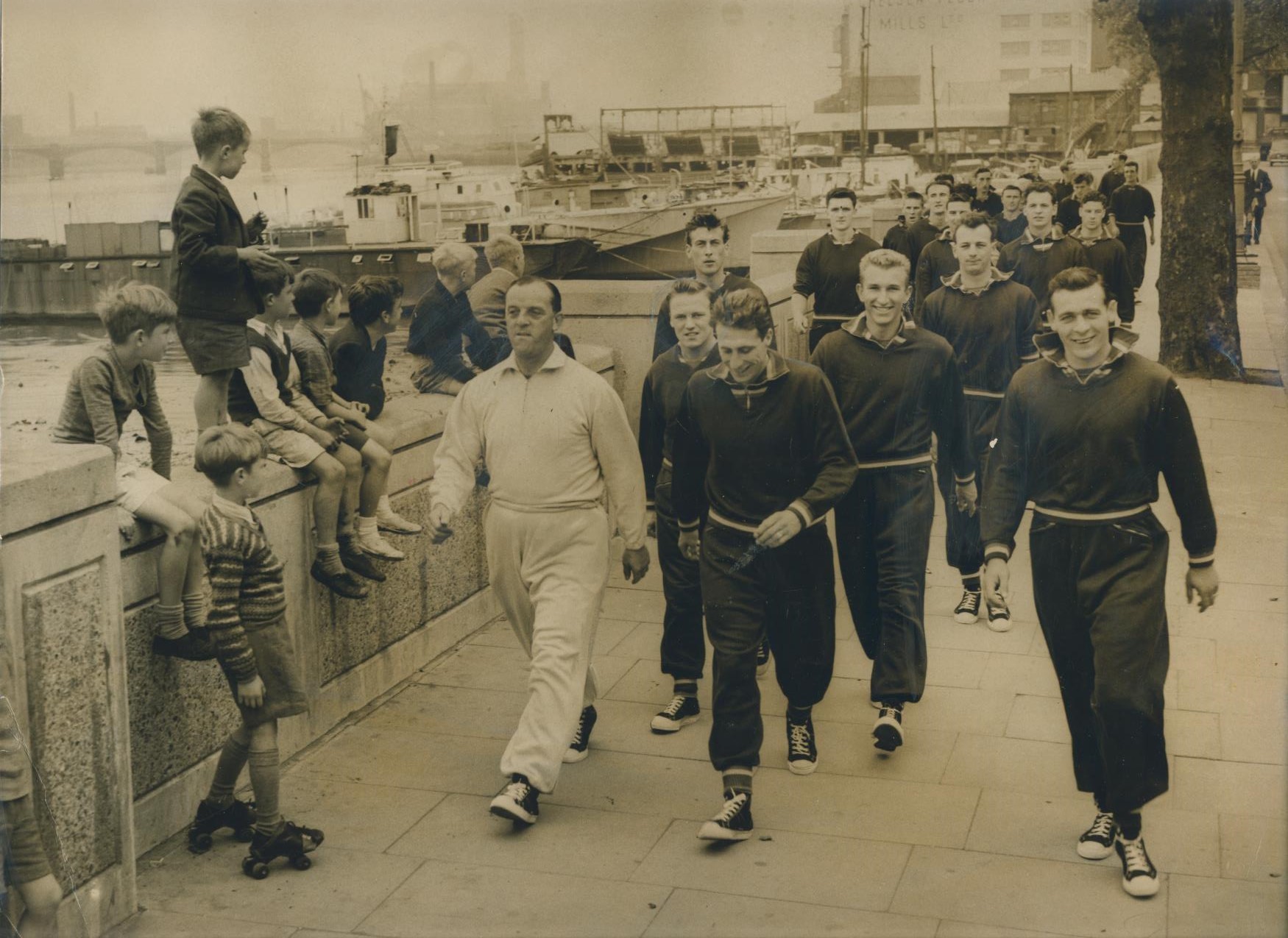
Enjoy a great image of 1957 Chelsea football players being led on a training walk by their then coach, Arthur Tennant. We love this press photograph – a fantastic time capsule and snapshot of a Chelsea football team, who probably felt reasonably confident that they were on the up and up by that point. They had enjoyed their first major trophy success a couple of years earlier by winning the League Title in 1955. In 1957 they were preparing to debut at their first European competition: the 1957-58 Inter-Cities Fair Cup. Chelsea had in fact been invited to their first European competition two years earlier in 1955. The French football magazine, L’Equipe, had invited them to take part in the inaugural 1955 UEFA European Cup. The Football League blocked Chelsea’s participation, however. They felt the tournament would be a distraction to domestic football!
1957 Chelsea football players training on the Chelsea embankment
The young and ambitious Ted Drake had been managing Chelsea since 1952 and by 1957 he had remodelled Chelsea football club and its players significantly. Drake had brought in successful, new signings and improved the youth set up. He changed the club’s image fundamentally too – gone was the old ‘Pensioners’ crest. In came the rebranded ‘Blues’. Perhaps this press photograph is part of that rebranding? A jaunty shot of the ‘Blues’ on a training walk in their training kit and very cool, uniform trainers!
It’s fascinating to see how freely the players were able to walk through central London with little sense of being mobbed by the public. It’s also amazing to see the children watching the players as they pass by – what child would be able to stand atop the embankment wall with his/her back to the Thames now?!
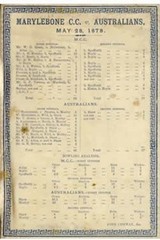
Rare & unusual Cricket Scorecards – our new cricket catalogue is out. We’ve struggled to keep the item numbers down in the catalogue. There are simply too many cricket scorecards with great stories to tell on our website! Some of the scorecards stand out due to their age. An I Zingari v the Liverpool Club cricket match took place on 19th July 1859. An extremely rare scorecard from the first ever Australian Tour of England in 1878 tells a painful early story of England Cricket.
MCC v Australians 1878 Cricket Silk Scorecard
The game was at Lord’s. Somehow the Australians scored only 41 yet won the match by 9 wickets. England, led by WG Grace, were bowled out twice in an afternoon, scoring just 33 and 19. The scorecard belonged to Alick Bannerman, the famous “stone-waller”, and has his name printed to the reverse.
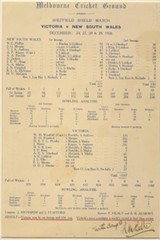
VICTORIA V NEW SOUTH WALES 1926 (RECORD SCORE OF 1107)
Another cricket scorecard stands out due to the match’s extraordinary score. On 24-29th December 1926 Victoria amassed a still unbeaten First-Class record score against New South Wales at Melbourne. Victoria made 1107 runs over the five days. Ponsford was top scorer, having made 352 runs. Arthur Mailey was hit for a soul-destroying 362 runs in his 64 8-ball overs. New South Wales lost – unsurprisingly – by an innings and 656 runs. It remains only the third heaviest defeat in history…so far.
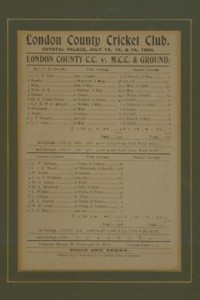
Other cricket scorecards in the catalogue tell stories that bring in outside elements to cricket itself. Footballing legend Geoff Hurst’s only First Test Match score was in a cricket match in 1962 . Another of the cricket scorecards in our catalogue introduces a significant element of interest outside cricket. In July 1902 London County played the MCC at Crystal Palace. London County won by an innings with Wood, Poidevin and WG Grace all scoring centuries for County. But the real intrigue is the appearance of one Sir A Conan Doyle for the MCC team, who scored his highest first-class score in the match. He made 43 runs.
Sir Arthur Conan Doyle’s appearance for the MCC in 1899
Sir Arthur Conan Doyle (1859-1930) was a hard hitting, though not especially skilled, batsman and a bowler of slow, loopy lobs which often took a puzzling flight. Indeed he once quipped that so slow was his bowling that if he ever delivered one he didn’t fancy could run down the wicket, intercept it, and come back for another go! In 1899, for the MCC, he took seven for 61 against Cambridgeshire at Lord’s and on the same ground two years later carried out his bat for 32 against Leicestershire. It is said that Shacklock, the Nottinghamshire player, inspired him with the Christian name of his famous character, Sherlock Holmes, and that of the latter’s brother Mycroft was suggested by the Derbyshire cricketer of that name.
If a picture tells a 1000 stories, it turns out cricket scorecards tell 1000s more! There are many more stories told by the cricket scorecards in our catalogue and on our website. Take a look.
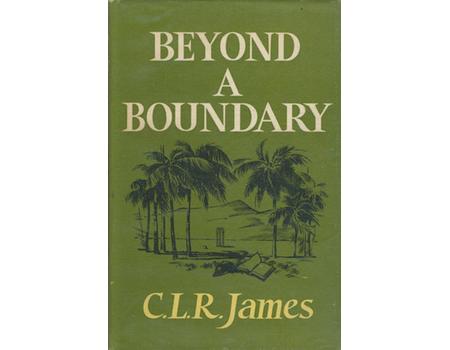
As many of you may know, it’s officially World Book Day today. In an office surrounded by 1000s of amazing sports books it was hard to choose only one title to celebrate the day We could have chosen many, but we went for C L R James’ ‘Beyond a Boundary’, described by John Arlott as ‘the finest book written about cricket’. Of course it’s about a lot more besides…
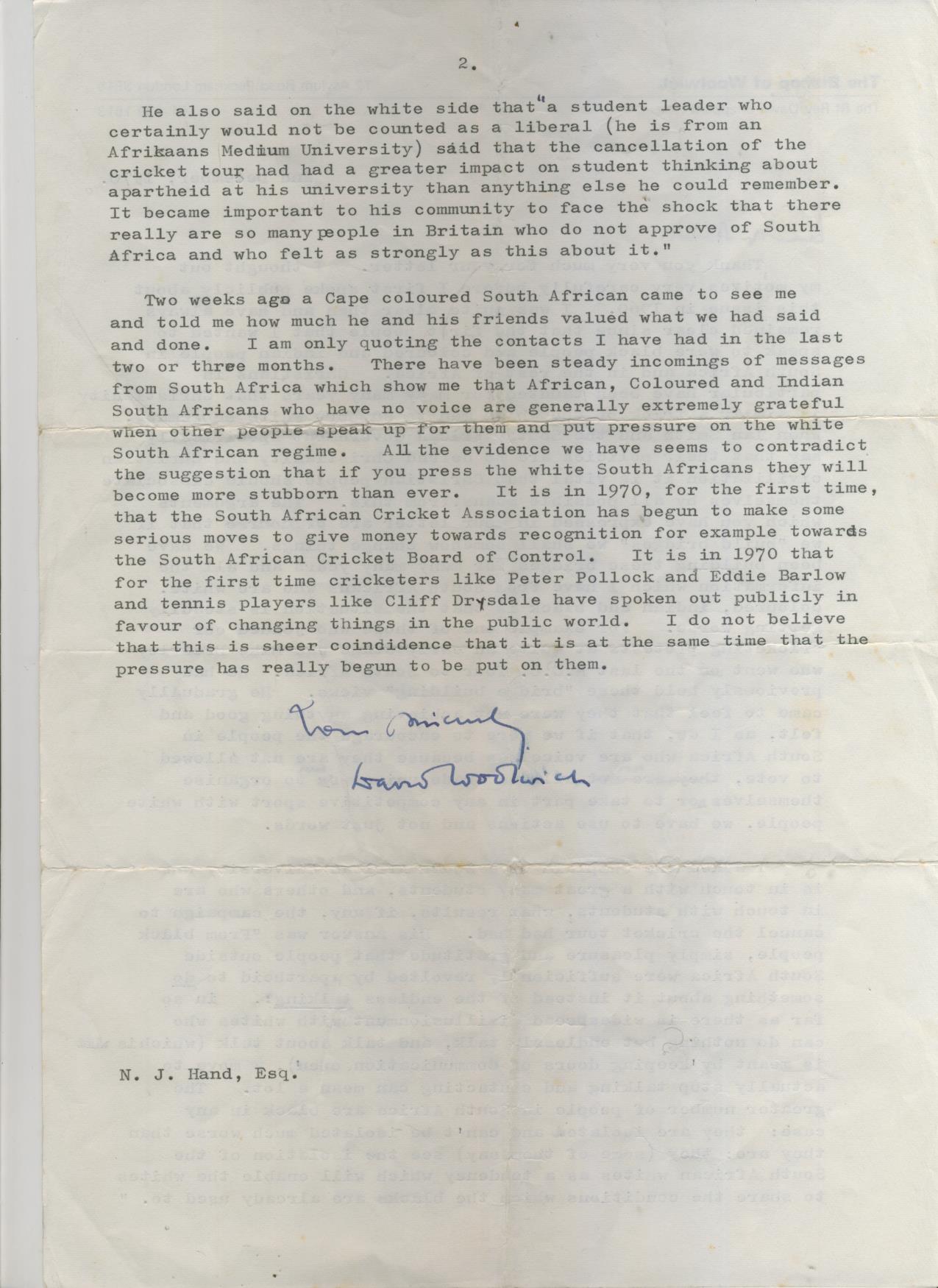
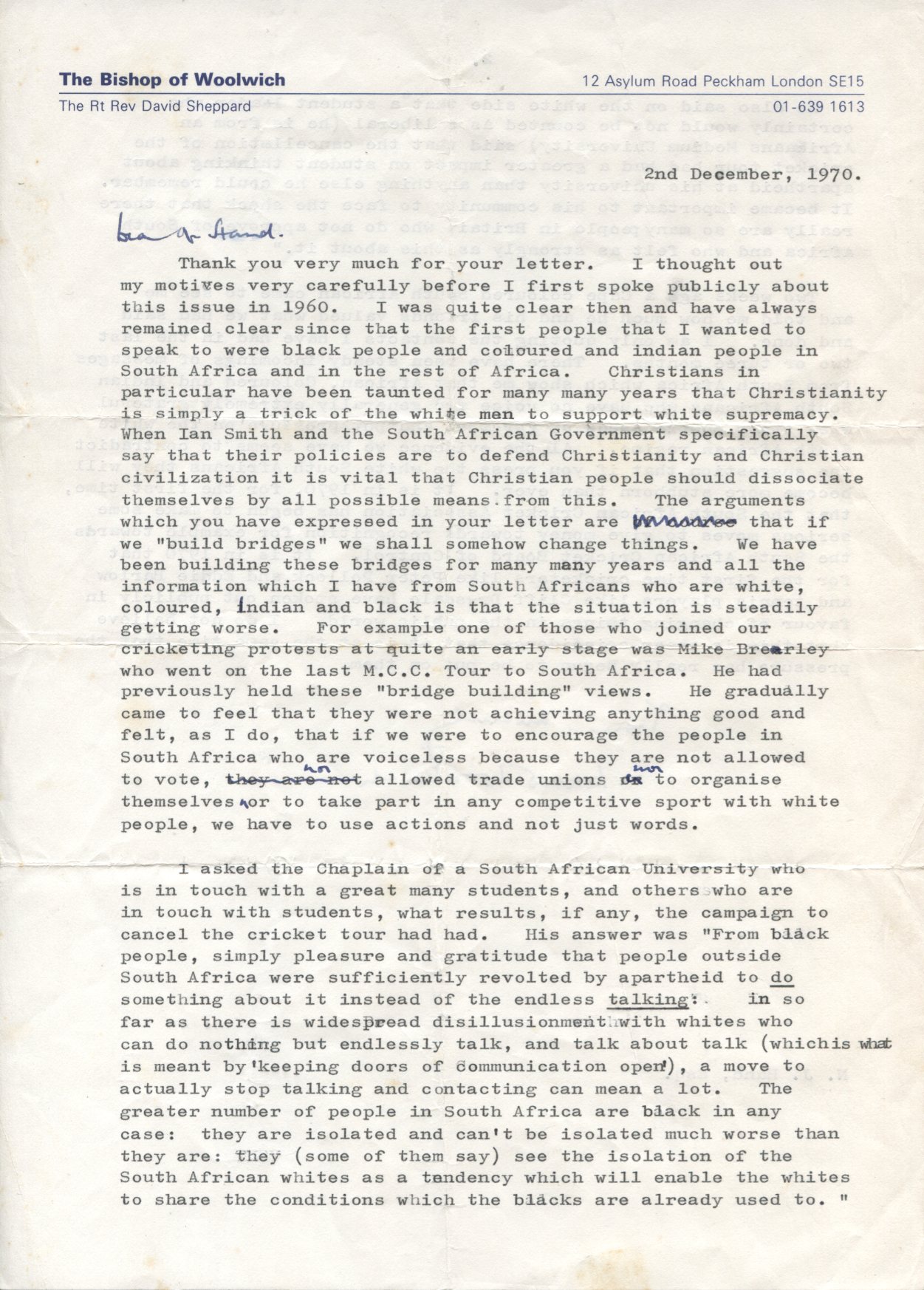
A letter written by David Sheppard, Sussex & England cricketer & Bishop of Woolwich and Liverpool, takes us back to the bleak days of cricket in Apartheid South Africa.
The 2016 England cricket team’s performance in South Africa so far must have cheered the heart of every England cricket fan. We have seen some phenomenal individual performances and a rousing, generally consistent team one, all at the expense of the hitherto World No 1 team: South Africa. Attention has turned very quickly to South Africa’s woes. Observers see South Africa’s struggles against England as symptoms of a demise rather than a blip. South African cricket may well be facing the need for an overhaul. It’s a cyclical pattern in all teams – but let’s not lose sight of how far South Africa have come in the last 25 years. This year will be the 25th Anniversary of the unification of South African cricket and its readmission to the international cricket arena. A journey down memory lane with David Sheppard, the extraordinary combination of clergyman and cricketer, reminds us of South African cricket’s journey.
David Sheppard is the only ordained minister to have played Test cricket. He was both a religious leader and a cricketer at the highest levels. Captain in turn of Cambridge and Sussex, Sheppard was an opening batsman. He scored more than 2,000 runs in each of the three seasons from 1951 to 1953, including 24 centuries in the process. Sheppard was one of Wisden’s Cricketers of the Year in 1953. He managed, too, to be an integral member of the England cricket team from 1954 to 1963 while pursuing a clerical career, which culminated in his hugely significant and influential role as Bishop of Liverpool in the 1980s.
Throughout Sheppard’s clerical career he was an outspoken supporter of the poor. He was also a strong opponent of South Africa’s then political system of Apartheid. David Sheppard refused to play cricket against the touring South Africans in 1960. He also oppposed the proposed MCC tour to South Africa in 1968-69 in which South Africa would not allow Basil D’Oliveira to play.
As the Bishop of Woolwich, David Sheppard wrote this letter in 1970. Here he sets out clearly his views about England cricket’s relationship with South Africa at the time.
David Sheppard’s letter about cricket and Apartheid
David Sheppard’s letter gives us a fascinating insight into the background, experiences and discussions circling England cricket’s relationship with South Africa at the time. With the benefit of hindsight, we can see how wise Sheppard was in his views. The letter is an important reminder of a great England cricketer and South African’s cricketing history. David Sheppard’s letter should be a reason for celebration. It may have a way to go, but South African cricket has come a long way too.
Sportspages has taken a look at BBC’s Sports Personality of the Year candidates since the programme began in 1954. The runner, Sir Christopher Chataway won it that first year. We’ve delved into our archives to detail a winner from each decade. Since all were worthy victors in the years that they won, our selection of individuals has been fairly arbitrary. Almost all could have caught our attention. We’ve tried to be fair (in sport?!) and picked out a sports personality from different sports over the years.
Jim Laker’s 10 wickets in the 1955 Ashes at Old Trafford
We start with Jim Laker, who won Sports Personality of the Year in 1956 for his record-breaking number of wickets taken against the Australians in that year. In the 4th Ashes Test, at Old Trafford, Laker was the first bowler in history to take all 10 wickets in a test innings. In fact Laker took 19 Australian wickets for 90. He bowled 9 for 37 in the first innings; 10 for 53 in the 2nd Innings.
Jim Laker later went on to set the record of the most wickets taken in a 5 match Ashes series (admittedly, a niche area): 46, a record still held today.
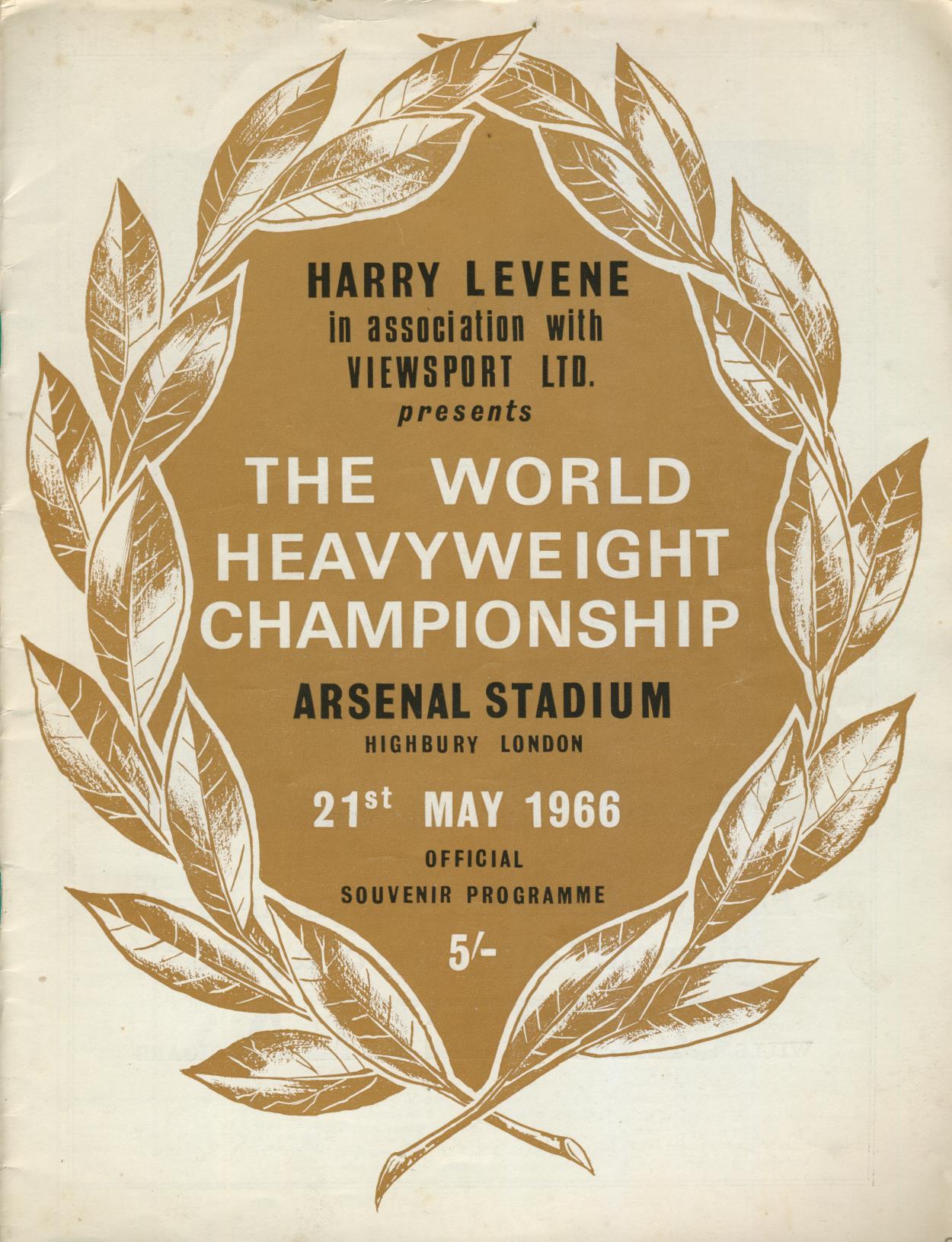
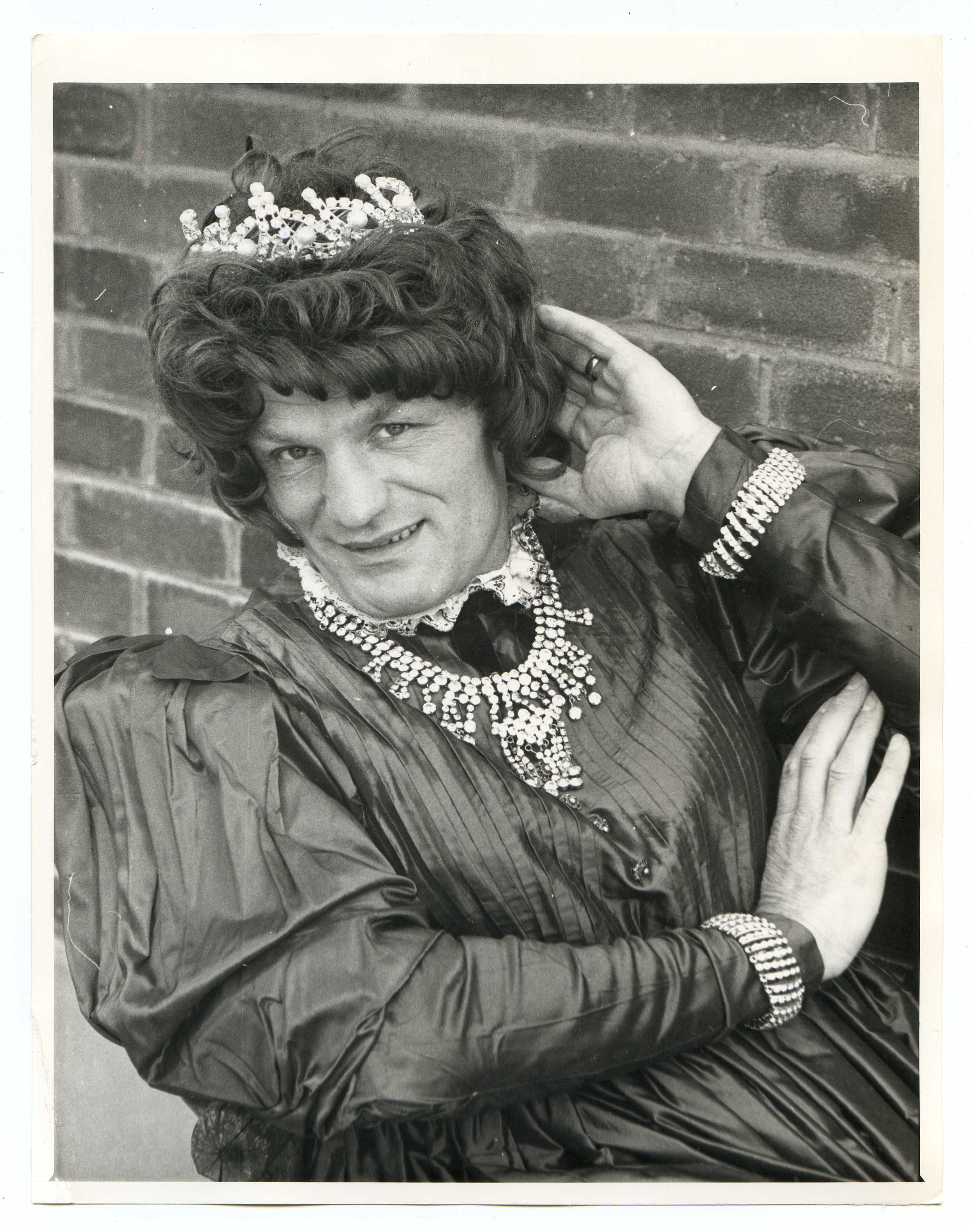
In the 1960s our attention turns to Sir Henry Cooper, the only British boxer ever to be knighted…yet. He was BBC Sports Personality of the Year in 1967, having been unbeaten throughout that year. We may have fond and more recent memories of him in Brut aftershave commercials and hamming it up in pantos and chat shows. He also had an exceptionally long career as a successful boxer from 1954 – 71. He won 40 of his 55 contests, 27 of which were knockouts. Cooper was legendary for his very powerful and very fast left hook. It was called ‘Enry’s Ammer’ and was most famously used against Muhammad Ali in both of their hugely publicised fights in 1963 and again in 1966. As well as Henry Cooper’s boxing achievements, he was also the first sportsman to win SPOTY twice – he won the award again in 1970.
Henry Cooper v Muhammad Ali boxing programme, 1966We couldn’t resist – Henry Cooper in panto
Mary Peters, Olympic Gold Medallist
We come to Dame Mary Peters in the 1970s. She won SPOTY in 1972 after her triumphant gold medal in the pentathlon at the 1972 Olympic Games in Munich, where she narrowly beat the local favourite. Mary Peters came from Northern Ireland and was a ‘war horse’ in athletics. She represented Northern Ireland at every Commonwealth Games between 1958 – 1974. She honed her craft in tough times. She recalled her training schedule every day, ‘I used to have to get two buses into Belfast City centre and then another to the track, carrying my shot, which weighed four kilos, and my starting blocks. The track was full of pot-holes. It wasn’t the ideal place to come but it was the only place we had’.
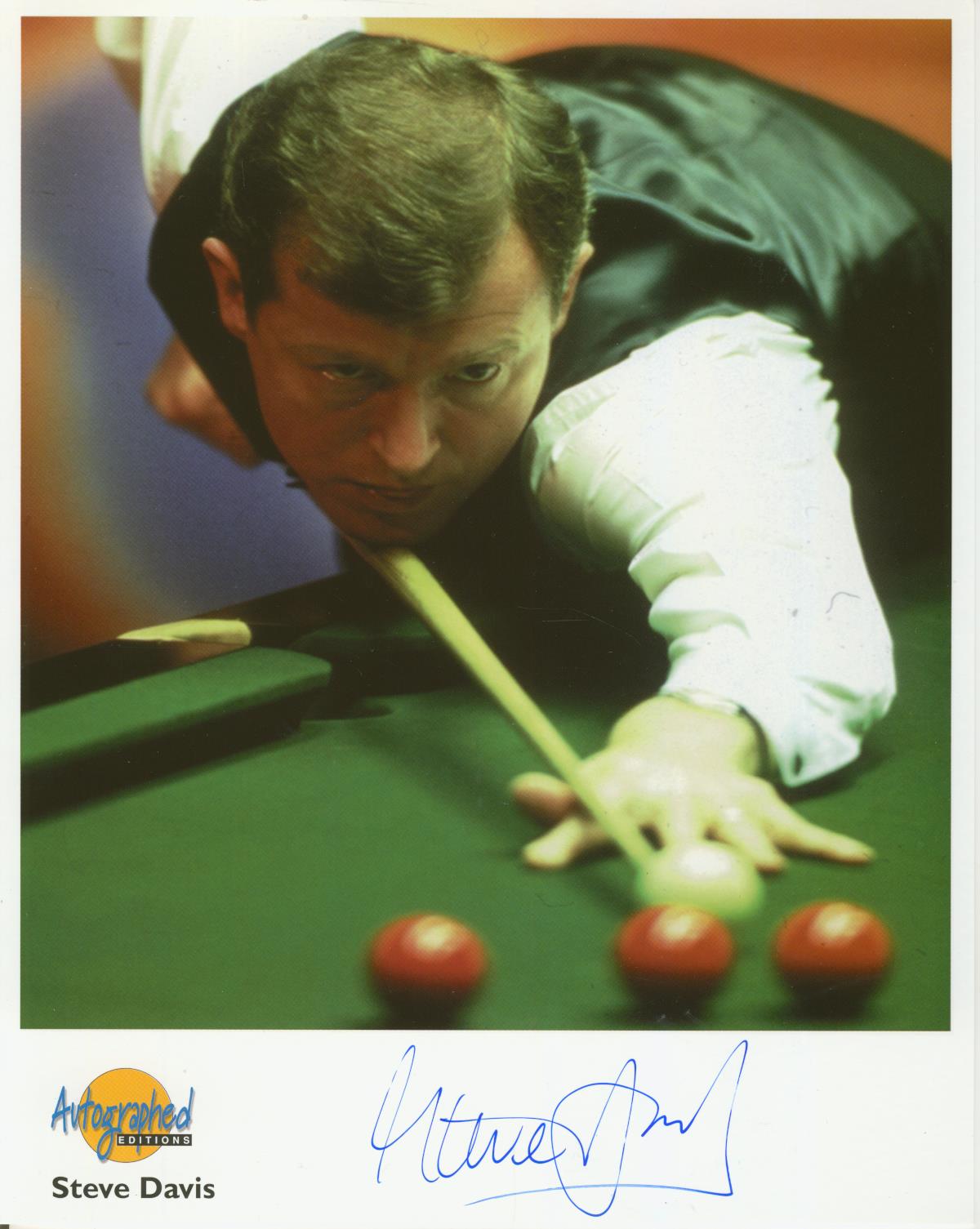
Steve Davis, Sports Personality of the Year 1988
The 1980s offers us almost too many fine candidates from which to choose. We could have concentrated on Beefy Botham. Unsurprisingly he won Sports Personality of the Year in 1981. There was Daley Thompson too, Torvill and Dean, Nigel Mansell and Sir Nick Faldo among others. But we wanted to share the love among sports and also to honour a fond favourite of ours: Steve ‘Interesting’ Davis! Davis was the first player to complete snooker’s triple crown in a single year to win the World Championship, the Masters and the UK Championship won Sports Personality of the Year in 1988. He went on to win the world championships six times in total. Steve Davis was ranked no. 1 in snooker for seven consecutive seasons and his 1985 World Championship final against Dennis Taylor pulled in 18.5 million British viewers.
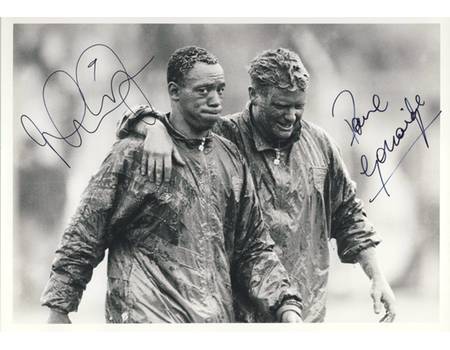
England football: Paul Gascoigne & Ian Wright
Steve Davis was accused of being boring at times due to his seeming lack of emotion and expression. In that case our 1990s Sports Personality of the Year might be the Yang to Steve Davis’ Ying. Footballer Paul Gascoigne, SPOTYS winner in 1990 was known as much for his passion and tears on the pitch as for his exceptional, natural talent. He won that year for being an integral part of the England team that reached the last 4 places in the 1990 World Cup in Italy. His tears afer the semi-final defeat against Germany reached the hearts of many fans. He wasn’t all tears though. He ended up with 57 caps and was described as the ‘most naturally gifted English midfielder of his generation’
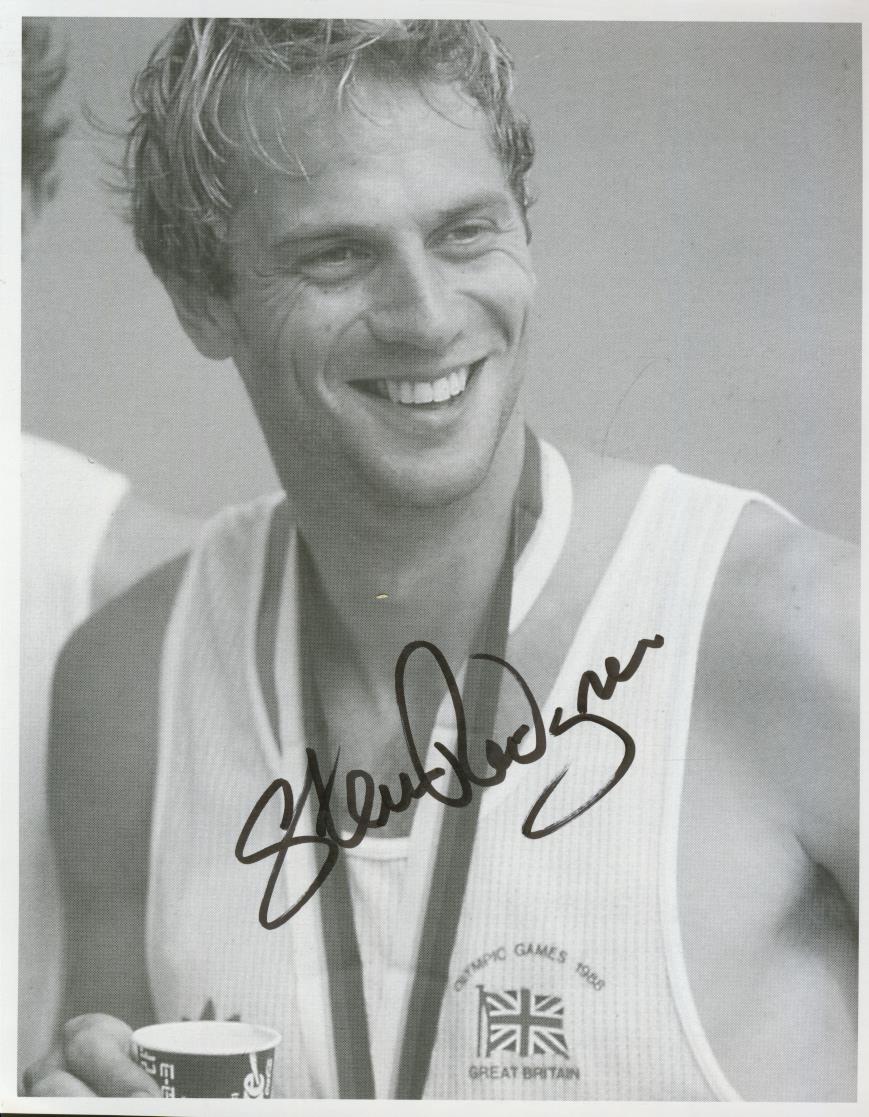
Sir Steve Redgrave in 1988 at the Seoul Olympics
The Noughties was another decade packed with fantastically achieving Sports Personalities of the Year. They included David Beckham, Paula Radcliffe, Jonny Wilkinson, Freddie Flintoff, Sir Chris Hoy and Ryan Giggs. All were worthy winners. We have gone for a huge sporting figure, literally and figuratively: Sir Steve Redgrave. Steve Redgrave ended his career being the most successful rower in history. He won 5 successive Olympic Gold medals and 1 bronze. He was onto his third Olympics and 3rd Gold medal in 2000 when he won Sports Personality of the Year then.
Since 2010, two of the past winners are contenders again this year: Andy Murray in 2013 and Lewis Hamilton last year. Will one of them do a ‘Henry Cooper’ and win Sports Personality of the Year for the second time this year? Will our Olympics poster girl, Jessica Ennis-Hill or Lizzie Armitstead step up as one of the few women to win the title over the years? Can Mo Farah or Chris Froome stay the course? Or will Kevin Sinfield, Greg Rutherford, Adam Peaty or Max Whitlock whip the trophy out from under the frontrunners’ noses? So many questions! Thankfully it’s only 10 days to find out the answers…